Breadcrumbs: Palm Lines > Head Line
Head Line in Palmistry: Location, Shapes, and Traditional Meanings
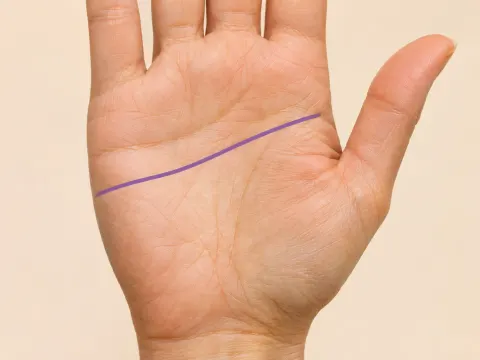
In palmistry, the head line, also called the mind line, is one of the three major palm creases. It starts near the edge between the thumb and index finger, runs horizontally below the heart line, and crosses the middle of the palm. Traditional guides interpret its shape and forks symbolically rather than measuring intelligence.
Where to Find the Head Line on Your Palm
To locate the head line, look at the central area of your palm between the upper horizontal crease and the curving crease around the base of the thumb. Introductory guides such as Cassie Uhl's overview of the major lines group the heart line, head line, and life line together as the three primary landmarks to identify before looking at finer details, as covered in our major palm lines guide.
These three creases sit in a top-to-bottom order on the palm:
- Heart line: runs across the upper palm just below the base of the fingers.
- Head line (mind line): begins on the thumb side between the thumb and index finger and travels across the middle of the palm below the heart line.
- Life line: curves downward around the ball of the thumb toward the wrist.
How the Head Line Starts Near the Life Line
The starting point of the head line sits on the radial edge of the palm between the base of the thumb and the base of the index finger. Because the life line begins in the same zone, palm readers first look at how the two lines relate at their origin. In Astrogle's guide to the head line and Mail.ru's overview of the mind line, locating this starting area is the main visual step for distinguishing the crease from nearby lines.
Joined Start vs. Separate Start (When the Head Line and Life Line Do Not Meet)
If you are wondering what it means when the life line and head line do not meet, you are noticing a visual variation in where the two creases begin:
- Joined start: the head line and life line touch or share a short path at the edge of the palm before separating across the hand.
- Separate start: the head line begins with a visible gap above the life line between the thumb and index finger, so the two lines do not meet.
Astrogle notes three starting variations in traditional palm reading, including a joined start with the life line and a separate start. Symbolic palmistry treats these starting positions as traditional talking points for self-reflection, not as factual indicators of personal character, brain function, or future behavior.
Straight, Curved, and Long Head Lines in Palmistry Tradition
Once you trace the head line from its origin toward the outer edge of the palm, you can observe its overall path and length. Cassie Uhl's guide to the major lines traditionally links the contour of the head line to symbolic approaches to thought:
- Straight head line: runs relatively level across the center of the palm. Uhl's overview traditionally associates this straight path with a logical or direct approach to thinking.
- Curved or sloping head line: bends downward toward the wrist side of the outer palm. The same traditional overview symbolically associates a curved line with imagination.
- Observable length: you can also notice whether the crease stops near the center of the palm or reaches closer to the outer edge. While readers sometimes ask how a long head line relates to thinking style or career choice, a palm crease cannot determine your profession, intelligence, or abilities.
| Visual Feature | What to Look For on the Palm | Traditional Symbolic Scope | Boundary |
|---|---|---|---|
| Location | Middle crease below the heart line, starting between thumb and index finger | One of the three major palm lines (head, heart, life) | Visual landmark only |
| Start near life line | Touching the life line at the start or separated by a visible gap | Traditional variation in how the two creases begin | Not a test of personality or behavior |
| Straight vs. curved path | Level path across the palm vs. downward curve | Associated in Cassie Uhl's guide with logical approach (straight) or imagination (curved) | Symbolic tradition, not an IQ or cognitive score |
| Forked end vs. double line | One line splitting into branches vs. two complete, roughly parallel lines that are comparable in length and roughly equally deep (not a short sister line or a markedly fainter shadow line) | LifePalmistry distinguishes a single branched crease, a short sister line, and a fainter shadow line from a double line, linking the double line to multiple ways of thinking | Author interpretation, not a diagnosis or prevalence fact |
Forked Head Line vs. a Double Head Line
As the head line reaches the middle or outer palm, it may split into branches. A forked head line is a single crease that divides into two or more smaller branches along its course or at its tip.
A fork is visually different from a double head line. As explained in LifePalmistry's guide to multiple head lines, parallelism alone does not define a double head line: the guide requires both lines to be complete, comparable in length, and roughly equally deep across the middle of the palm, and explicitly distinguishes a double head line from a short sister line or a markedly fainter shadow line. By contrast, a forked line is one main crease that branches out. LifePalmistry links the double head line to the symbolic idea of multiple ways of thinking. This remains an authorial interpretation within palmistry rather than a psychological measurement, diagnosis, or prediction of life events.
What about a Broken Head Line?
Readers also ask what a broken head line means when the crease appears interrupted by gaps or overlaps. Visually, you can notice whether the crease runs as one continuous line or appears in separate segments along the middle of the palm. This palmistry guide explains traditional symbolic reading only and cannot diagnose or assess health, head injury, mental well-being, or future events.
Free Palm Line Observation
The ReadThePalm web tool uses a palm photo for a free visual observation of the three major lines: the life line, heart line, and head line.
- What the free reading covers: basic visual observation of the life, heart, and head lines for entertainment and self-reflection.
- Scope boundary: this symbolic overview does not measure intelligence, assess or diagnose health, or predict future events.
Related Palm Lines
- Palm Lines Overview — see how the head line fits alongside the heart line, life line, and secondary creases.
- Double Head Line in Palmistry — compare a single branched head line, a short sister line, or a fainter shadow line with two complete, roughly equally deep head lines of comparable length.
How We Write About Palmistry
We present palm reading as a traditional symbolic practice for self-reflection and entertainment. Our explanations draw on named introductory references—including Cassie Uhl (Basic Palmistry — The Major Lines), Astrogle (Significance of Head Line in Palmistry), Mail.ru Horoscopes (Line of the Mind), and LifePalmistry (Multiple Head Lines)—to help you identify visual landmarks on the palm without treating traditional lore as scientific, medical, or psychological fact.
Last updated: October 31, 2026