Fate Line in Palmistry: How to Find the Saturn Line and Read Its Shape
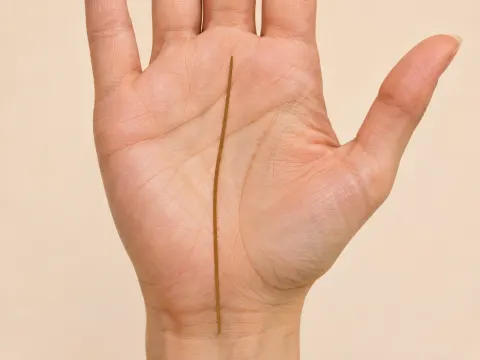
In palm reading, the fate line—also known as the Saturn line, career line, or luck line—is a vertical crease that runs up the middle of the palm toward the base of the middle finger. Traditions associate it with life path and work themes, though it is not present on every hand and never guarantees career outcomes or wealth.
How to Locate the Vertical Fate Line on Your Palm
To find the fate line, look for a vertical crease rising through the center of the palm toward the base of the middle finger. In traditional palmistry, this mark is also called the Saturn line (note that the line of Saturn and the mount of Saturn at the finger's base are distinct features). Rather than curving around the thumb like the life line or crossing horizontally like the head and heart lines, the fate line travels upright. For a broader look at how major creases fit together, see our guide to palm lines.
Its starting point and length can take different forms:
- Starting in the middle of the palm: The crease may only become visible near the center of the hand rather than rising from the wrist.
- Stopping short of the finger: A vertical line may end in the middle of the palm—for instance, meeting or stopping near the horizontal head line—without reaching the base of the middle finger.
- Comparing both hands: Palmistry traditions differ on which hand to prioritize. One traditional approach compares both palms and treats the everyday working (dominant) hand as the active hand regardless of gender, while other schools follow different rules.
Note on age timing: While some traditions discuss measuring age or turning points along the fate line, there is no single verified method for calculating timing from a palm crease.
Absent, Broken, or Branched Lines: Visible Variations Without Predictions
When examining your palm, you may notice that the vertical line is faint, broken into segments, branched, or completely missing. In traditional palm reading, interpretations of these variations differ across schools, and none of them serve as a factual forecast of your future.
| Visible Variation | How It Appears on the Palm | Traditional Context & Boundary |
|---|---|---|
| Absent fate line | No clear vertical crease running toward the middle finger | Treated in traditional guides as a normal variation rather than a bad omen or a sentence; claims that it proves complete freedom of choice or lack of direction are unverified beliefs, not facts. |
| Branched or forked line | Smaller splits or offshoots rising from or joining the main vertical crease | Visually distinct from a single straight crease; a branch does not predict a career switch. |
| Broken or segmented line | A vertical crease interrupted by gaps along the center of the palm | Represents a segmented crease pattern; it does not diagnose personal setbacks or guarantee life disruptions. |
| Short line stopping early | A crease that begins in the middle of the palm or stops before the middle finger | A structural variation; where the line ends does not cap your career potential or achievements. |
Why It Is Called the Career or Luck Line—and How Adjacent Lines Differ
In everyday palmistry guides, the terms "career line," "job line," and "luck line" usually refer to the fate line. Reference traditions such as The Old Farmer's Almanac symbolically associate the fate line with a person's general life path. Popular guides also connect it to work and daily effort, which is why career and fate labels point to the same vertical crease.
However, when traditions discuss fortune or material themes, they also distinguish neighboring features rather than looking at the fate line alone:
- The Sun line (Apollo line): Another vertical crease, traditionally associated in The Old Farmer's Almanac with creativity and recognition. You can compare their positions in our Sun line guide.
- Money lines: Separate traditional markings linked in popular palmistry to finances and material themes. See how traditions distinguish them in our money line overview.
Regardless of whether a guide calls the crease a fate line, career line, or luck line, these labels describe symbolic traditions. No crease on the hand guarantees job security, promotions, financial gain, or specific life events.
Explore Your Palm Lines
On the main palm reading page, a free observation covers the life, heart, and head lines as an introductory guide to the three major creases.
Frequently Asked Questions
What is the career line on the hand?
In palmistry, the "career line" or "job line" is another name for the fate line (or Saturn line)—the vertical crease directed toward the base of the middle finger. Traditions link it symbolically to work and life path, though it cannot predict your actual profession or success.
What does it mean when the fate line stops at the head line in palmistry?
Visually, the fate line does not always reach the base of the middle finger; traditional guides note that it can begin in the middle of the palm or stop short before the finger. While specific event forecasts for stopping at the head line are not supported by verified evidence, a shorter crease is simply a physical variation and does not limit your future.
What does my fate line say?
Traditionally, readers look at whether the line is present, continuous, or branched to reflect symbolically on life path and focus. Because interpretations vary between schools and are not scientific facts, it helps to view your fate line as a prompt for self-reflection rather than a prediction of career or financial outcomes.
Related Palm Lines
- Palm Lines Overview — how the major and minor creases are mapped on the hand.
- Sun Line on the Palm — comparing the vertical Apollo line and its traditional themes of creativity and recognition.
- Money Line on the Palm — how traditional money markings differ from the career and fate line.
How We Write About Palmistry
We present palm reading as a historical and symbolic tradition, not as science, medical diagnosis, or financial forecasting. Our descriptions of line location and visible variations draw on The Old Farmer's Almanac (September 21, 2026) for traditional life-path associations, Horoscopes Mail.ru (reviewed October 31, 2026) for locating the Saturn line and its structural variations, and Vedora (September 4, 2026; verified October 31, 2026) for hand-comparison approaches.
Last updated: October 31, 2026