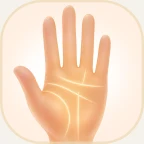
The Letter M on the Palm: Lines and Traditional Meaning
In palmistry, the letter M is not a separate line on the hand, but an outline formed where major palm creases meet near the center of the palm. Traditional guides connect this combined figure with leadership, though accounts differ on which lines create it and traditional symbolism offers no rarity statistic or guaranteed wealth.
Which Palm Lines Form the Letter M
Unlike standalone shapes that appear as small independent marks, the M pattern is read as a meeting of primary creases across the middle of the hand. For a broader look at how standalone figures and combined line patterns are categorized, see the overview of palm signs and markings.
Palmistry sources do not share a single universal rule for which creases complete the four strokes of the letter M. Depending on the reference you consult, guides describe the figure either as a combination of the three primary creases alone or as a pattern that requires a vertical fourth crease.
Auntyflo's 2020 introductory guide attributes the M outline to the combination of the heart line, the head line, and the life line. By contrast, a Russian reference overview by iiset includes the vertical fate line alongside those major creases to complete the four-part contour. Because hand creases vary in angle and length, neither description serves as a single universal standard for every palm.
| Reference Account | Creases Included in the M Outline | How the Shape Is Formed |
|---|---|---|
| Three-line description (Auntyflo, 2020) | Heart line, head line, and life line | The upper horizontal, diagonal middle, and curving lower creases meet or angle toward one another in the center of the palm |
| Four-line description (iiset overview) | Heart line, head line, life line, and fate line | A vertical fate line rises through the center of the palm, adding a fourth stroke between the major creases |
How to Distinguish the M Pattern from Separate Signs
A clear M contour depends on whether the major creases visibly connect or angle together across the middle of the palm rather than running in wide, unconnected arcs. Checking each crease individually helps separate an everyday combination of main lines from an independent palm mark.
- Locate the curving life line around the base of the thumb, the diagonal head line across the center, and the upper heart line beneath the fingers.
- Observe whether these main creases—or an upward vertical fate line between them in four-line accounts—meet or angle closely enough to form an M-like outline.
- Separate the full-palm M outline from smaller standalone figures such as a cross, triangle, or crescent moon, which traditional guides treat as distinct markings in specific areas of the hand.
If the major creases run parallel with wide gaps between them, or if a faint skin fold only appears when you cup your hand, the palm simply shows standard separate lines rather than a joined M figure.
Traditional Meaning and Its Limits
Popular palm reading guides treat the letter M as a symbolic motif rather than a verified indicator of ability or future events. Reading this pattern clearly means separating traditional lore from unsubstantiated promises.
What does it mean to have an M shape on your palm?
Having an M shape on your palm means that your primary palm creases angle together near the middle of the hand to resemble the letter M. Traditional palmistry commentary links this contour with leadership, while anatomy treats it simply as the natural geometry of palmar flexion creases.
What does an m mean in palm reading?
In palm reading tradition, commentary such as Auntyflo's 2020 guide associates an M formed by the major creases with leadership. However, this interpretation is a symbolic tradition rather than a factual assessment of personality or ability, and it does not predict financial gain, career outcomes, luck, or life events.
Traditional commentary on the letter M does not establish any measured rarity statistic for how often this crease arrangement appears on the hand, and the pattern offers no guarantee of wealth, luck, or success.
Exploring the Three Main Lines on ReadThePalm
Because the M figure is built from the primary creases of the hand, examining those foundational lines is the most direct way to understand the layout of your palm. In the ReadThePalm web tool, the free photo observation focuses on the life line, heart line, and head line, while reference guides explore how traditional palmistry interprets combined patterns such as the letter M.
Related Guides
- Palm signs overview — how traditional palmistry groups standalone marks and line combinations.
- The life line — where the lower curving crease runs around the thumb base and what tradition says about it.
- The head line — how the central crease crosses the palm and forms the middle angle of the hand.
- The heart line — how the upper crease runs beneath the fingers and completes the top edge of the central palm area.
How We Write About Palmistry
We present palmistry as a historical and symbolic tradition for self-reflection, not as science, medicine, or a way to predict the future. Traditional descriptions on this page draw on Auntyflo's introductory guide to the letter M (published February 5, 2020) and the iiset reference overview of palm signs, noting where their accounts of the constituent lines differ.
Last updated: October 31, 2026