The Crescent Moon in Palmistry: Checking the Two-Palm Curve
In Astrotalk's palmistry commentary and in this guide, a crescent moon—or half moon—refers to the curved shape that can appear when you bring both palms together and align your heart lines. Viewed here as a two-palm outline rather than a single-hand mark, it is treated symbolically, not as a prediction of marriage or future events.
How to Spot the Half-Moon Shape Across Both Hands
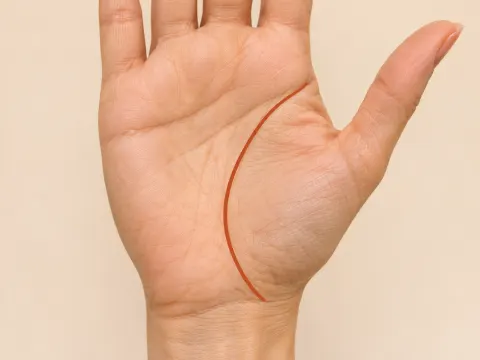
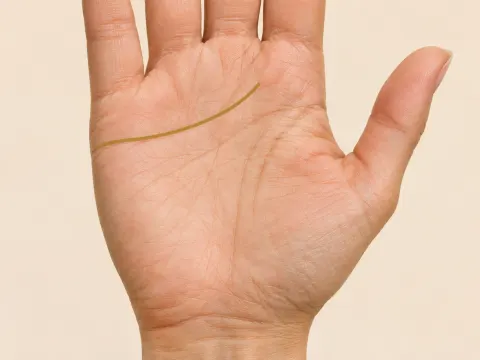
To check whether your hands form a crescent moon, hold both palms face up side by side and bring them together so the sides below the little fingers touch. Gently align your hands at the level of the heart line—the top horizontal crease that runs beneath the base of the fingers.
As Astrotalk notes in its 2022 guide What to notice about the half-moon, bringing both palms together and matching the heart lines can sometimes create a continuous upward arc across the two hands. Because everyone's creases sit at slightly different heights and angles, the resulting figure varies:
- A smooth crescent: Both heart lines curve upward at a similar angle and meet where the two palms touch, forming a single U-shaped or bow-like arc.
- A straight or flat line: The creases meet at roughly the same level but run horizontally across the palms with very little curve.
- An uneven or stepped meeting: One heart line sits higher than the other, or the two creases angle differently so they do not form a connected curve when the hands are held comfortably.
How the Crescent Differs from Single-Palm Signs
Unlike classic palm signs that are read on a single hand—such as a cross, a triangle, a star, or the letter M formed by the major creases—the half-moon pattern described in Astrotalk's guide depends on how two palms meet. Changing the tilt of your wrists or pressing the sides of the hands together at a different angle can alter how aligned the two heart lines look.
For that reason, it helps to look at each heart line on its own first, with the hand relaxed, before comparing how the two sides line up together.
For a broader overview of single-hand markings and traditional patterns, see our guide to palm signs.
What Palmistry Traditions Say About the Half Moon
What does a half moon on the palm mean? In contemporary palmistry writing, the joined-palm arc is treated as a symbolic motif rather than a fixed rule. In Astrotalk's traditional overview, for example, a clear half-moon curve is associated with themes of independence, though such interpretations are symbolic folklore rather than established facts or relationship predictions.
A curved line across both palms does not predict marriage, a partner's appearance, or guaranteed life events, and it does not measure personality traits as factual outcomes. It is simply a visual way to notice whether the heart lines on your left and right hands mirror each other.
Observing the Three Main Lines
Because the crescent moon pattern forms where the heart lines meet rather than from a separate small mark, looking at the primary creases on each hand gives a clearer starting point. ReadThePalm provides a free observation of the three main lines—the life line, heart line, and head line—from a palm photo, while individual palm signs and two-hand shapes are covered in our reference guides.
How We Write About Palmistry
We present palmistry as a traditional symbolic practice for self-reflection, not as science, medical advice, or a way to predict the future. Descriptions of the crescent moon on this page draw on published palmistry commentary, including Astrotalk's What to notice about the half-moon (December 20, 2022), and separate symbolic folklore from marriage or personality predictions.
Updated: October 31, 2026