Triangle in Palmistry: Closed Shape, Line Crossings, and the Money Triangle
In palmistry, a triangle is a closed figure with three distinct sides on the palm that traditional commentaries distinguish from casual line crossings. Some schools associate this shape with knowledge, while a specific pattern called the money triangle connects the head, fate, and Mercury lines without guaranteeing wealth or future income.
How a Closed Triangle Differs from Ordinary Line Crossings
Because palm creases intersect in many places, traditional guides treat the triangle as one of several distinct palm signs only when all three sides clearly meet.
Palmistry defines a triangle as a closed figure with three sides, not an open angle or a loose overlap of creases. In an article on palm triangles for Goroskopy Mail, the author contrasts a fully closed three-sided shape with accidental intersections where major and minor creases cross one another.
When looking at your palm, check two basic visual criteria:
- Three complete sides: Each side is a visible crease segment rather than an imagined line between separate marks.
- Closed corners: All three vertices meet without wide gaps or unrelated creases cutting through to create a random grid.
According to the same Goroskopy Mail commentary, some palmistry schools connect a clear triangle with knowledge. This association belongs to symbolic tradition rather than a measurement of ability, education, or future achievement.
The Money Triangle vs. Individual Money Lines
Palmistry texts also use the word triangle for a specific pattern called the money triangle. In its guide to wealth signs, Astroyogi describes the money triangle as a closed shape where three named lines meet in the central palm:
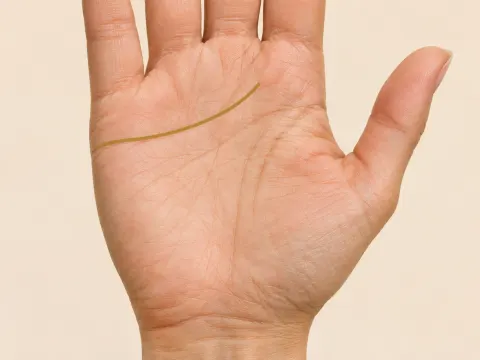
- The head line along the upper edge of the shape
- The fate line forming one side through the center of the palm
- The Mercury line closing the third side toward the base of the little finger
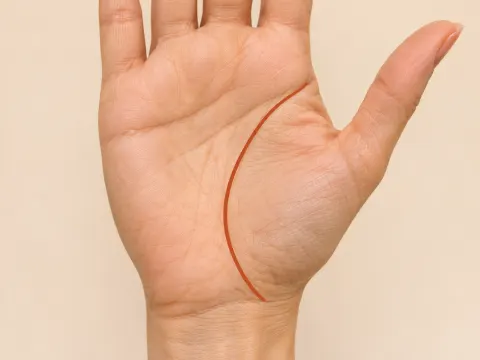
The Astroyogi overview separates this three-line configuration from individual money lines on the palm, which the same source locates from the thumb base toward the center of the palm. Because one term can refer to a three-line enclosure and the other to a line running from the base of the thumb toward the palm center, keeping them separate prevents confusion when you compare palm reading guides.
Traditional claims linking the money triangle to savings or financial gain are folk beliefs, not factual indicators. No crease pattern on the hand predicts or guarantees income.
Symbolic Meaning and Boundaries of Interpretation
Traditional palmistry treats a triangle as a symbolic sign rather than a prediction. While Goroskopy Mail notes that some schools link a closed three-sided triangle with knowledge, this remains a traditional reading rather than a test of skill or intellect. Likewise, Astroyogi presents the money triangle—formed by the head, fate, and Mercury lines—as one specific pattern rather than the only definition of a palm triangle or a guarantee of financial gain.
Palmistry literature also treats crosses, stars, bracelets, and palm mounts as separate categories rather than variations of the triangle.
How We Write About Palmistry and Line Observation
We present palmistry as a historical and symbolic tradition, attributing interpretations to specific texts and schools instead of stating them as facts about personality, events, or finances.
In the ReadThePalm web experience, a free palm observation covers the three main lines—the life line, heart line, and head line—for reflection, while reference guides like this article cover smaller palm signs such as triangles.
Updated: October 31, 2026