Broken Heart Line in Palmistry: Visual Gaps, Lookalikes, and Traditional Meaning
In palmistry, a broken heart line is a crease across the upper palm where the line stops completely, leaving a visible gap before continuing. Traditional palm reading views this break as a symbolic theme of an emotional turning point, not a prediction of divorce, a breakup, or any medical condition.
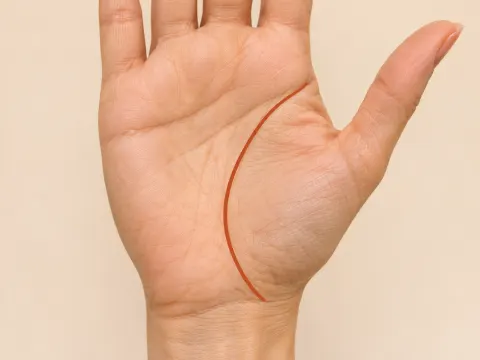
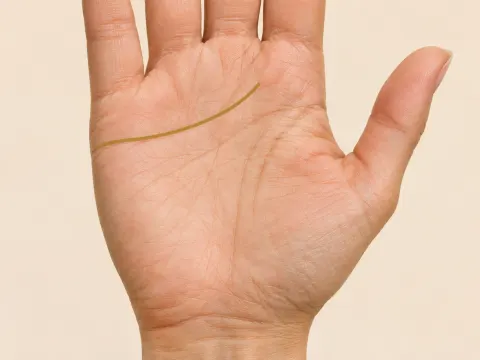
Where the Heart Line (Love Line) Sits on Your Palm
When looking at the major creases covered in our guide to palm lines, readers often mistake faint skin texture or uneven lighting for a break. Check where the crease sits and how its ends meet to separate a true gap from neighboring markings.
The heart line—often called the love line in English palm reading—runs horizontally across the top of your palm, starting near the edge beneath the little finger and curving toward the index or middle finger. Because crease depth and length vary naturally from hand to hand, trace the full path of the main heart line before judging any interruption along it.
A genuine break means the crease stops completely and resumes after a clear space of unmarked skin. On a photograph, an external shadow or harsh side lighting can make a shallow section look like a gap even when the crease is continuous on the palm.
How a True Break Differs from Chains, Islands, and Overlapping Ends
Several upper-palm markings look similar at first glance, including lines that split or run side by side. Look at how the ends behave to avoid confusing a broken crease with other traditional patterns:
| Pattern on the Heart Line | What It Looks Like on the Palm | How It Differs from a Simple Break |
|---|---|---|
| True gap (broken line) | The crease stops completely, leaves an open space, and starts again further along the palm. | The two segments do not touch, loop together, or run side by side. |
| Overlapping break | One segment ends while the next segment starts slightly above or below it, so the ends overlap. | The line shifts tracks instead of leaving an empty gap along a single path. |
| Island | The line splits into two thin branches that soon rejoin, enclosing a small oval space. | The crease divides and closes back together rather than stopping. |
| Chain | A series of small connected links runs along the crease. | The links remain joined; there is no open break between segments. |
| Double heart line | A separate second line runs alongside the main heart line. | It forms a distinct pair of lines rather than a single interrupted crease. |
If you are wondering what a branched heart line means when a crease splits, first check whether the split closes back into the main line to form an island or runs as a separate double line. Detailed traditional meanings for open branches at the ends of the crease belong to the broader study of the heart line.
What Traditional Palmistry Says—and What a Break Cannot Predict
Traditional palmistry commentaries such as Muhurat Choghadiya describe a broken heart line symbolically as a theme of an emotional turning point. Other popular guides, including PalmSays, distinguish clean breaks, overlapping ends, and double lines, and state that historical authors such as Mrs. B. Dale, Cheiro, and Comte C. de Saint-Germain offered various interpretations of these patterns.
Regardless of the school or author, a gap in the heart line is a symbolic tradition rather than an established fact about your life:
- No breakup or divorce forecast: A broken crease does not predict the end of a relationship, marriage trouble, or future emotional pain.
- No proof of past events: Skin creases do not record past heartbreaks or personal history.
- No medical assessment: Despite the name, this guide and ReadThePalm do not diagnose medical conditions or assess health, physical illness, or lifespan from the heart line.
Exploring the Three Major Lines
Because small gaps, islands, and lighting shadows are easy to confuse on a flat image, ReadThePalm offers a free observation of the three main lines—the life line, heart line, and head line—for reflection and entertainment, without claiming to automatically detect or classify specific line breaks or minor signs from a photo.
How We Write About Palmistry
We present palmistry as a cultural and symbolic tradition, not a science, diagnostic tool, or way to foretell events. Visual definitions and traditional attributions in this article draw on published palmistry guides, including Muhurat Choghadiya ("Broken Heart Line," published January 15, 2025; publisher-reviewed October 6, 2026), PalmSays ("Heart Line," accessed October 31, 2026), and Purple Garden ("The Location of Heart Line In Your Palms," May 18, 2023).
Last updated: October 31, 2026