What a Broken Life Line Means in Palmistry
In traditional palmistry, a broken life line is a visible gap along the curved crease around the base of the thumb. Palm reading traditions treat a break as a symbolic pattern, and this guide does not provide a medical diagnosis or a prediction of lifespan. See how major creases relate in our overview of palm lines.
Important to Know
Neither the length of the life line nor a break along its curve shows how long you will live. Palmistry is a symbolic tradition, not a medical or scientific tool: creases on the palm do not diagnose health conditions, measure physical vitality, or predict death, illness, or future events.
How to Spot a Break and Distinguish Nearby Lines
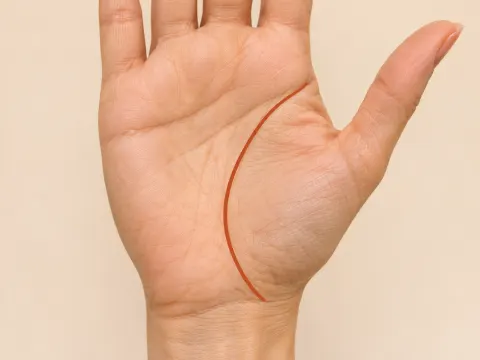
To check your life line, look at the crease that curves around the thumb base toward the wrist and trace its path from start to finish. A break appears as a distinct interruption where the main arc stops and resumes, or steps slightly to the side beside a parallel crease.
Because several creases cross the center of the palm, a normal neighboring line or a branched ending is easy to mistake for a gap. Checking the main arc first helps separate three common patterns:
| Pattern on the palm | How it looks | How traditions treat the shape |
|---|---|---|
| Broken life line | The curve around the thumb base stops and continues after a gap or an offset parallel segment | Treated as a symbolic break in the line's path, not a sign of death or illness |
| Split or forked life line | A continuous line divides into two branches without a gap in the main crease | Viewed as a branching shape rather than an interruption; it does not predict future events |
| Neighboring Head Line or sister line | A separate crease runs above or alongside the life line curve | Read as an independent palm line or companion crease rather than a break in the life line |
For a complete look at the main arc, its location, and its traditional symbolism, see the guide to the life line on the palm.
How Palmistry Traditions Interpret a Broken or Split Pattern
In palm reading traditions, the life line is associated with symbolic themes rather than physical survival. For example, Russian palmistry guide Lunelia connects the main arc with ideas of personal grounding, home, and roots, while Batya Weinbaum in the Santa Barbara Independent addresses the common fear around a broken life line by framing the gap as a symbolic shift in direction and noting that "exact dating is never possible."
When the crease divides into a fork instead of stopping, readers treat it as a split shape rather than a break. Across these traditional views, neither a gap nor a fork is evidence of guaranteed life events, trauma, or changes in health.
Why a Break Does Not Predict Lifespan or Events
A common question is whether a broken or short life line means a short life. Traditional palmists who address this fear state directly that the life line does not measure longevity.
In a 2019 anatomical study published in Anthropological Review, researchers Lucas, Dhugga, and Henneberg examined the hands of 60 deceased individuals donated to the University of Adelaide and found no statistically significant relationship between life line length and age at death. The study tested a single hypothesis about line length in that sample—it did not examine breaks in the line and does not evaluate palmistry as a whole. Whether a life line is short, continuous, split, or interrupted by a gap, the crease is a physical fold of the skin and never a forecast of death or health.
Common Questions About Checking the Life Line
What does the life line represent in palm reading?
In symbolic palmistry traditions, the life line is linked to themes such as grounding, home, and personal roots (as described in the Lunelia guide). It does not represent medical vitality, physical health, or the length of a person's life.
How do I check my life line?
Find the curved crease that wraps around the mound at the base of the thumb and follow it toward the wrist, separating it from the Head Line above it. Looking at the whole arc helps you see whether the crease is continuous, forked, or interrupted by a gap.
What does a short life line mean in palmistry?
Introductory palmistry guides state directly that the life line does not determine longevity (for example, Ryland Peters). A shorter arc is simply a variation in crease length, not a sign of a shorter life.
What if the life line splits?
A split life line branches into two paths while the crease itself stays connected, whereas a broken life line has a visible interruption. Like a break, a split is a visual variation in the crease and does not predict events or dates.
Palm Line Observation
In the ReadThePalm web tool, a free observation covers the three main palm creases—the life line, heart line, and head line—for entertainment and self-reflection.
How We Write About Palmistry
This guide presents palmistry as a cultural and symbolic tradition. We attribute traditional interpretations to specific published guides—such as Batya Weinbaum (Santa Barbara Independent, 2007), Ryland Peters (2019), and Lunelia—and cite anatomical research (Lucas, Dhugga, and Henneberg, Anthropological Review, 2019) strictly within the scope of its tested hypothesis.
Last updated: October 31, 2026
Related lines
- Rare Palm Lines: Traditional Names, Shapes, and BoundariesRead guide
- Broken Heart Line in Palmistry: Visual Gaps, Lookalikes, and Traditional MeaningRead guide
 The Life Line in Palmistry: Location, Variations, and MeaningRead guide
 Heart Line on the Palm: Location, Shapes, and Traditional MeaningRead guide