Short Life Line in Palm Reading: Does It Mean a Short Life?
A short life line in palm reading does not mean a short life. Palmistry guides note the crease does not predict longevity, while a 2019 study of 60 donated bodies at the University of Adelaide found no statistically significant correlation between life line length and lifespan. Compare the major palm lines to locate it.
Important to Know
The length of the life line does not show how long you will live. Palmistry is a symbolic tradition, not a medical or diagnostic tool, and the creases on your hand cannot predict lifespan, health, or future events.
How to Find the Life Line and Judge Its Arc
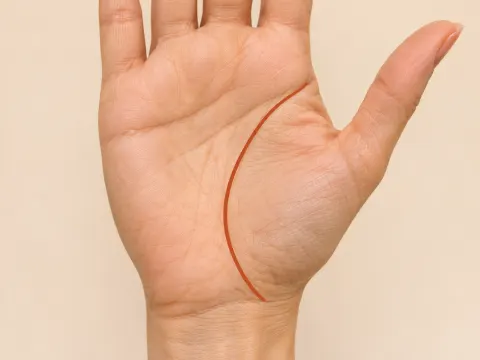
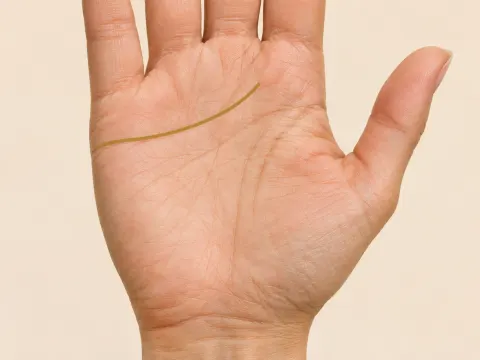
To see whether your life line is short, first separate its curve from the neighboring creases on your palm. In palmistry guides such as Ryland Peters' overview of the four major lines and the Russian reference guide Lunelia, the life line forms an arc that curves around the base of the thumb, while the head line runs above it across the center of the palm.
Once you trace the arc around the thumb's base, see how far the crease extends toward the wrist. Checking where the curve begins and ends helps you avoid confusing a shorter arc with the head line beside it.
| Crease or feature | Where to look on the palm | How to tell them apart |
|---|---|---|
| Life line | Curves in an arc around the base of the thumb | Follows the rounded thumb base rather than crossing the center |
| Short life line | Follows the same curve around the base of the thumb | Ends higher on the palm instead of continuing further down the arc |
| Head line | Starts near the same area and runs across the middle of the palm | Extends horizontally or diagonally across the palm rather than curving around the thumb |
What a Short Life Line Means in Palmistry Traditions
In palmistry traditions, the life line is read as a symbolic theme rather than a measure of years. Guides such as The Old Farmer's Almanac and Ryland Peters state directly that the crease does not determine longevity. In one symbolic tradition described by the Russian palmistry guide Lunelia, the life line is associated with themes of support, home, and roots.
Because these guides read the crease symbolically, a shorter arc around the thumb base does not indicate a shorter life. For a broader look at how palmists interpret the full crease, see our guide to the life line on the palm.
Why Life Line Length Does Not Predict Lifespan
Modern palmistry guides state that a short life line does not predict an early death, and an empirical study tested whether life line length correlates with longevity. In a 2019 study published in Anthropological Review (DOI: 10.2478/anre-2019-0011), researchers Lucas, Dhugga, and Henneberg measured life line length and age at death in 60 bodies donated to the University of Adelaide.
The authors reported that "no significant correlations were found" between the length of the life line and longevity in that sample, while noting that earlier studies had reported conflicting results. This study tested only that single hypothesis on 60 donated bodies—it does not evaluate every palmistry claim or say anything about a reader's health, and it shows why crease length should not be read as a timer for life.
Observing the Main Lines on a Palm Photo
ReadThePalm offers a free symbolic observation of the three main creases—the life line, heart line, and head line—from a palm photo in the online palm reading tool. The free overview focuses on these general lines for entertainment and self-reflection.
How We Write About Palmistry
We present palmistry as a cultural and symbolic tradition rather than science or medicine. Every interpretation is attributed to specific reference guides—such as The Old Farmer's Almanac (September 21, 2026), Ryland Peters (May 17, 2019), and Lunelia—and empirical claims are limited to the exact hypothesis tested, such as Lucas, Dhugga, and Henneberg (2019).
Last updated: October 31, 2026