Palmistry Bracelets and Other Minor Lines on the Hand
In palmistry, bracelet lines—also called rascia—are horizontal wrist creases at the base of the hand below the palm. Readers separate these wrist markings from minor palm creases such as the Girdle of Venus, the intuition line, and travel lines. Each crease is interpreted through symbolic tradition rather than as a sign of health, age, or future events.
What Are Bracelet Lines (Rascia) in Palm Reading?
Bracelet lines are horizontal creases located where the inner wrist meets the base of the palm. Leo Markun (1927) refers to these markings as "The Bracelets or Rascia" and describes them as wrist creases sitting below the palm itself, while Asttrolok places them right at the junction of the palm and wrist.
When looking at your own hand, start by separating these wrist creases from the lines inside the palm. Because they sit on the flexing joint of the wrist, they belong to the boundary below the mounts rather than the main palm surface. Traditional commentary treats them strictly as symbolic folklore; they do not measure health, longevity, or ages of life.
For a broader overview of how major and secondary creases fit together across the hand, see the palm lines guide.
Minor Lines Across the Palm at a Glance
Beyond the wrist bracelets, palmistry guides group several smaller or less discussed markings under minor lines. Checking their position relative to the fingers, the outer edge of the palm, and the palm mounts helps distinguish one crease from another.
| Line Name | Reported Location in Palmistry Sources | Attribution and Scope |
|---|---|---|
| Bracelet lines (Rascia) | Horizontal creases at the junction of the palm and wrist, below the palm surface | Leo Markun (1927); Asttrolok |
| Girdle of Venus | Arc or broken arc above the heart line near the bases of the fingers | Leo Markun (1927); Palmistry Path |
| Intuition line | Semicircular crease; in one mapping, running from the Mount of Moon via Mars toward Mercury | Leo Markun (1927) for shape; Auntyflo for mount path |
| Travel lines | Short creases on the outer edge of the palm in the Moon area, or branches from the life line toward the Mount of Moon | Leo Markun (1927); Astroscience |
| "Education line" | Disputed: no single named line in older books, applied to the head line or a branch, or placed near the little finger | PalmSays vs. Nora Pennington |
The Girdle of Venus Above the Heart Line
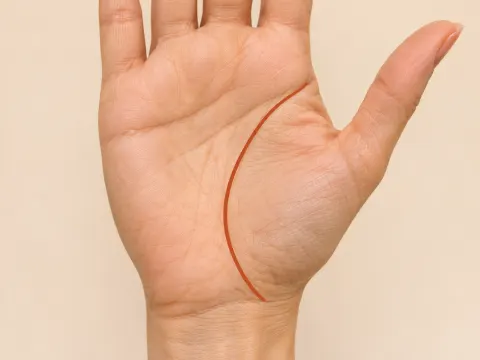
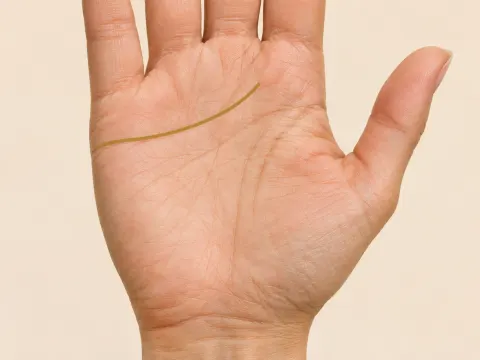
The Girdle of Venus sits at the top of the palm, opposite the wrist bracelets. Leo Markun (1927) describes it as a semicircle located beyond the ring of Saturn. Palmistry Path places this arc—or series of partial arcs—above the heart line near the bases of the fingers, using the space between the index and middle fingers and the space between the ring and little fingers as visual landmarks.
These descriptions offer a way to locate the crease on the upper palm, not a psychological or medical profile. In palmistry, whether the arc appears continuous or broken is a traditional reading detail rather than a fact about temperament.
The Semicircular Intuition Line
The intuition line is identified by its curved shape along the side of the palm. Leo Markun (1927) describes the intuition line as a semicircular crease that is sometimes joined at its ends to another line, without fixing a single path across the mounts.
A separate mapping from Auntyflo states that the line "starts on the mount of Moon" and curves in a semicircle via Mars toward Mercury. Because authors describe the path with different levels of detail, readers use the semicircular curve on the outer palm as a reference point from individual palmistry texts rather than proof of special abilities or intuition.
Travel Lines on the Mount of Moon and Life Line Branches
Palmistry sources describe two different visual patterns when discussing travel lines. Leo Markun (1927) notes that in one traditional interpretation, a branch leaving the life line toward the Mount of Moon is associated with travel, though this is not a universal layout for all travel markings. Astroscience describes short lines on the outer edge of the palm in the Moon area alongside branches from the life line heading toward that same region.
In both accounts, the connection to journeys or living abroad represents palmistry belief. Seeing short creases on the outer edge of the hand or a branch toward the Moon area does not predict a move, trip, or future relocation.
Why Palmistry Sources Disagree on the "Education Line"
Unlike wrist bracelets or the Girdle of Venus, the term "education line" has no single settled position in palmistry literature. PalmSays notes that the set of traditional books it reviewed contains no line by that name, and explains that some modern readers apply the label to the head line or one of its branches. By contrast, Nora Pennington places an education line near the little finger.
Because these accounts compete and traditional reference books do not establish a universal crease for schooling, no single position can be treated as standard. Regardless of which crease a modern guide points to, palm lines cannot predict academic study or educational outcomes.
Love Line vs. Marriage Line: Clearing Up the Names
Readers looking up minor lines often run into overlapping terms for relationship creases. In English palmistry guides, "love line" often refers to the heart line, which Purple Garden locates across the upper part of the palm with its own curve and branches. By contrast, the marriage line—which Auntyflo also calls affection lines—refers to the short horizontal creases near the base of the little finger.
Keeping these two zones separate prevents confusion when comparing charts from different traditions. Neither the upper heart line nor the smaller creases below the little finger can predict marriage, relationship dates, or partner outcomes.
Free Palm Observation
On ReadThePalm, the free observation covers the three main lines—the life line, the heart line, and the head line—from a palm photo, without breaking down these minor lines.
How We Write About Palmistry
This guide separates what you can see on the hand—such as wrist creases, upper-palm arcs, and outer-palm lines—from the symbolic meanings assigned by palmistry traditions. Location descriptions are attributed to specific authors, including Leo Markun (1927), Asttrolok, Palmistry Path, Auntyflo, Astroscience, PalmSays, Nora Pennington, and Purple Garden. We do not present palm creases as indicators of health, lifespan, personal fate, or guaranteed events.
Last updated: October 31, 2026